

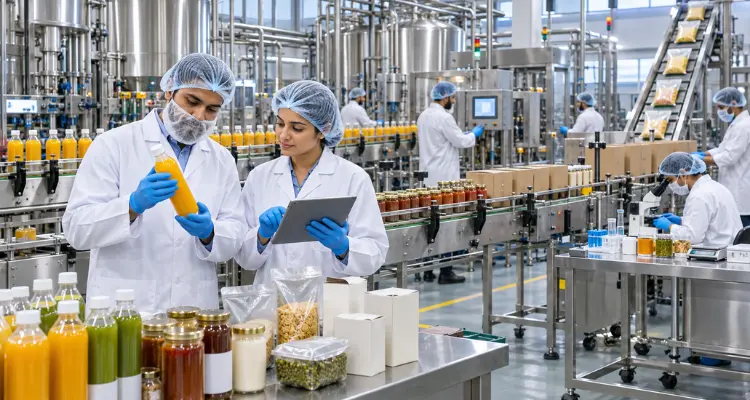
Quality Management Software for Food & Beverage and FMCG Manufacturers
Food and FMCG manufacturing teams work in a fast-moving environment where product quality, hygiene, supplier control, staff training, complaint handling, documentation, and audit readiness must be managed without slowing production.
AURA helps Quality Managers, Compliance Managers, Internal Auditors, ISO Consultants, Plant Heads, Food Safety Teams, and Production Leaders manage critical quality workflows from one centralized QMS platform.
With AURA, your team can manage food safety audits, plant audits, supplier audits, SOPs, training records, CAPA, customer complaints, quality actions, dashboards, and role-based workflows in one connected system.
Built for food and FMCG manufacturers that need stronger audit readiness, better document traceability, faster corrective action closure, and clear compliance visibility without depending on spreadsheets, shared folders, paper checklists, or manual follow-ups.
Industry Overview
Food and FMCG Quality Management Needs Speed, Control, and Traceability
Food & Beverage and FMCG manufacturers operate under high production pressure. Teams must manage hygiene checks, production audits, packaging inspections, supplier controls, customer complaints, staff training, SOP reviews, corrective actions, and compliance evidence across departments, shifts, plants, and locations.
In this industry, quality records must be both accurate and easy to retrieve. A delayed corrective action, missed training record, outdated SOP, incomplete hygiene audit, or unresolved supplier issue can affect audit readiness, customer confidence, product consistency, and brand reputation.
Many food and FMCG companies still manage quality workflows through:
- Excel-based audit schedules
- Paper hygiene checklists
- Shared folders for SOPs and forms
- Manual training registers
- Email-based CAPA follow-ups
- Separate supplier quality files
- Complaint registers maintained outside the QMS
- Department-wise production and packaging records
- Manually prepared dashboard reports
These methods may work for small teams, but they become difficult to control when the organization manages multiple products, shifts, SKUs, production lines, vendors, plants, and customer audit requirements.
AURA helps food and FMCG manufacturers move from scattered quality records to a structured, centralized, and audit-ready QMS platform.
It is especially useful for organizations managing:
- Internal food safety audits
- Plant and hygiene audits
- Supplier audits
- Packaging and production process audits
- SOP and document control
- Staff training records
- Customer complaint follow-up
- Non-conformance and CAPA tracking
- Quality task ownership
- ISO and food safety compliance evidence
- Real-time quality dashboards and reports
Common Quality and Compliance Challenges in Food & Beverage / FMCG Manufacturing
Audit frequency is high and follow-up is difficult
Food and FMCG manufacturers often conduct internal audits, hygiene audits, production audits, supplier audits, customer audits, plant audits, and food safety reviews. When these activities are tracked manually, findings may remain open, evidence may be incomplete, and audit closure may depend on repeated follow-ups.
SOP and document control gaps create operational risk
Food manufacturing teams depend on approved SOPs, cleaning procedures, allergen control instructions, production formats, packaging specifications, quality manuals, inspection checklists, supplier documents, and hygiene records. If outdated or uncontrolled documents are used, process consistency suffers.
Training records are hard to maintain across shifts
Food and FMCG plants often run multiple shifts with operators, supervisors, QA teams, maintenance teams, packaging teams, and warehouse staff. Training evidence can become fragmented when attendance sheets, SOP training records, and refresher training logs are maintained manually.
Hygiene and food safety checks lack centralized visibility
Cleaning records, sanitation audits, pest control observations, GMP checks, PRP checks, personal hygiene audits, and process hygiene findings may sit in different registers or departments. This makes trend review and corrective action tracking difficult.
Supplier quality records are scattered
Food manufacturers depend on raw material suppliers, packaging vendors, contract manufacturers, logistics partners, and service providers. Supplier audits, supplier findings, approvals, non-conformances, and corrective action responses can become difficult to track without a structured system.
Customer complaint handling is disconnected from CAPA
Customer complaints must be investigated, linked to root cause, assigned to responsible teams, corrected, verified, and reviewed for recurrence. When complaint records and CAPA workflows are managed separately, closure becomes slower and lessons may not reach production teams.
Plant heads lack real-time quality visibility
Leadership needs to know which audits are pending, which CAPA actions are overdue, which SOPs need review, which training items are incomplete, and where repeated quality issues are occurring. Manual reports often provide this information too late.
Compliance becomes person-dependent
If audit history, supplier follow-ups, document status, training records, or corrective action progress is known only to a few employees, the organization becomes vulnerable during audits, customer visits, employee turnover, and production expansion.
How AURA Supports Food & Beverage and FMCG Quality Teams
AURA centralizes audit management, document control, training management, CAPA, task tracking, dashboards, and reporting into one web-based QMS platform.
Instead of managing food safety and quality activities through separate spreadsheets, registers, emails, and folders, AURA helps teams create a connected workflow where records, responsibilities, approvals, actions, and evidence are easier to control.
Centralized Audit Management
Plan, schedule, assign, conduct, track, and close internal audits, supplier audits, hygiene audits, plant audits, customer audits, and process audits. AURA helps teams manage audit checklists, findings, observations, non-conformances, evidence, and closure status.
Controlled Document Management
Manage SOPs, food safety procedures, work instructions, hygiene checklists, cleaning procedures, packaging specifications, quality manuals, forms, policies, templates, and controlled records with version control, approval workflows, access permissions, archiving, and document history.
Training Management for Plant and Quality Teams
Assign and track training based on role, department, shift, SOP update, audit finding, hygiene requirement, customer complaint, or compliance need. This helps quality teams prove that employees have been trained on current procedures.
CAPA and Task Tracking
Convert audit findings, customer complaints, supplier issues, hygiene observations, and process non-conformances into corrective actions with defined owners, target dates, priority, evidence requirements, and closure tracking.
Supplier Quality Visibility
Manage supplier audit schedules, supplier findings, corrective action follow-ups, approval evidence, and supplier-related quality records from one system.
Real-Time Dashboards
Give Quality Heads, Compliance Managers, Plant Heads, and leadership teams visibility into open audits, overdue CAPA actions, pending document approvals, training gaps, supplier follow-ups, and quality task status.
Role-Based Access
Give users access based on responsibility. Quality teams, auditors, document owners, training coordinators, production heads, supplier quality teams, plant leadership, and auditees can work within controlled permissions.
Mobile Accessibility
Support shopfloor follow-ups, distributed teams, and multi-location plants with mobile-friendly access where applicable. This helps users review tasks, respond to actions, and access quality information more efficiently.
Workflow Automation
Automate reminders, approvals, audit assignments, CAPA follow-ups, document review alerts, training notifications, escalations, and reporting workflows to reduce repetitive manual coordination.
Key AURA Features for Food & Beverage / FMCG Manufacturing
| AURA Capability | Practical Benefit for Food & FMCG Teams |
|---|---|
| Audit Management | Plan audits, assign auditors, record findings, track non-conformances, manage evidence, and close audits systematically. |
| Document Management | Control SOPs, hygiene procedures, production formats, packaging specifications, manuals, forms, and templates with version history and approvals. |
| Training Management | Assign and track staff training based on roles, shifts, SOP updates, audit findings, hygiene requirements, and compliance needs. |
| CAPA Management | Track root cause, corrective actions, preventive actions, responsible owners, due dates, evidence, and closure status. |
| Supplier Audit Management | Manage supplier audits, supplier findings, corrective action responses, and supplier quality follow-up activities. |
| Assessment Management | Create food safety checklists, hygiene assessments, department audits, clause-based reviews, and process evaluations. |
| Task Management | Assign quality actions to responsible users and monitor closure across departments, plants, and shifts. |
| Dashboards & Reports | View audit progress, pending tasks, overdue CAPA, document status, training gaps, supplier follow-ups, and quality activity in real time. |
| Role-Based Access | Control who can create, review, approve, edit, close, or view quality records. |
| Customizable Workflows | Configure workflows around plants, departments, audit types, document categories, supplier requirements, approval levels, and compliance priorities. |
| Mobile-Friendly Access | Support plant-level follow-ups, distributed teams, and faster response to quality actions. |
Business Benefits
- Stronger audit and food safety readiness: AURA helps teams organize audit schedules, checklists, evidence, findings, CAPA actions, document references, training records, and closure reports in one place.
- Better SOP and hygiene document control: Food manufacturing teams can reduce the risk of outdated procedures, uncontrolled formats, missing approvals, and unclear revision history.
- Improved training compliance: Training records can be connected to roles, shifts, departments, SOP updates, hygiene requirements, and audit findings.
- Faster corrective action closure: Automated reminders, task ownership, dashboards, and evidence tracking help reduce delays in CAPA completion.
- Better supplier quality control: Supplier audits, supplier findings, corrective action responses, and approval records can be managed in a structured and traceable workflow.
- Reduced manual workload: Quality teams spend less time chasing updates, preparing reports, searching for records, and reconciling spreadsheets.
- Clearer visibility for plant leadership: Plant Heads and Quality Leaders can monitor quality activity, open actions, and compliance performance through real-time dashboard views.
Why Food & Beverage and FMCG Manufacturers Choose AURA
Unified Audit + Document + Training Platform
Many food safety and quality problems occur because audits, SOPs, training records, complaints, and corrective actions are managed separately. AURA connects these areas so teams can trace quality activity from an audit finding or complaint to CAPA, document update, training assignment, and closure evidence.
ISO-Focused and Food Safety-Oriented Workflows
AURA supports ISO-driven and compliance-heavy environments with structured audit planning, clause-based assessments, document control, training evidence, CAPA tracking, supplier audit workflows, dashboards, and audit-ready records.
Practical for High-Speed Manufacturing Teams
Food and FMCG teams need quality systems that support daily operations without slowing production. AURA is designed to reduce manual follow-ups and help users work with assigned tasks, reminders, checklists, dashboards, and centralized evidence.
Customizable for Plant and Product Requirements
Every food manufacturer has its own product lines, supplier base, plant layout, approval hierarchy, audit calendar, document categories, and customer requirements. AURA can be configured around your internal quality process.
Scalable for Multi-Plant and Multi-Location Operations
AURA supports growing manufacturers that need centralized visibility across plants while maintaining department-wise and location-wise accountability.
Affordable and ROI-Focused
AURA is suitable for organizations that want better audit control, document traceability, training compliance, and CAPA visibility without heavy implementation complexity or excessive software cost.
Standards and Compliance Areas Relevant to Food & FMCG Manufacturers
Food & Beverage and FMCG organizations may operate under different food safety, quality, hygiene, customer, export, retailer, and regulatory requirements depending on product category, geography, customer base, and certification scope.
AURA supports the workflows needed to manage audits, documents, training evidence, CAPA, supplier follow-ups, task ownership, dashboards, and compliance records.
ISO 22000
ISO 22000 is a food safety management system standard for organizations directly or indirectly involved in the food chain. AURA can support audit planning, document control, training records, corrective actions, food safety checklists, and evidence management for ISO 22000-oriented workflows.
FSSC 22000
FSSC 22000 is a food safety certification scheme aligned with the ISO management system approach. Food and FMCG companies can use AURA to support audit evidence, document control, CAPA, supplier audits, training records, and management review preparation.
HACCP and Codex Food Hygiene Principles
HACCP-based food safety systems require disciplined hazard control, monitoring, corrective actions, verification, documentation, and employee awareness. AURA can help teams organize the supporting audit, document, training, and corrective action evidence around these activities.
GMP and GHP Requirements
Good Manufacturing Practices and Good Hygiene Practices are central to food safety operations. AURA can support hygiene audits, cleaning procedure control, training evidence, corrective action tracking, and plant-level quality visibility.
FSSAI Schedule 4
For food businesses operating in India, FSSAI Schedule 4 requirements are relevant to hygienic and sanitary practices. AURA can support the organization of audit checklists, food safety records, SOPs, training evidence, corrective actions, and internal follow-up workflows.
BRCGS Food Safety
Food manufacturers supplying retailers or export markets may need structured systems for food safety, product quality, site standards, process control, personnel practices, and audit evidence. AURA can help manage related document, audit, training, and corrective action workflows.
ISO 9001
Some food and FMCG companies also maintain ISO 9001 quality management systems to improve process control, customer satisfaction, internal audits, corrective actions, documented information, and continual improvement.
ISO 22005
Where feed or food chain traceability is part of the organization’s scope, ISO 22005 may be relevant. AURA can support the management of quality records, audit evidence, corrective actions, and document control related to traceability processes, but it should not be positioned as a replacement for ERP, MES, or batch traceability systems unless integration and scope are confirmed.
How Food & FMCG Quality Teams Can Use AURA
Step 1: Define the audit program
Create audit schedules for internal audits, hygiene audits, supplier audits, plant audits, packaging audits, customer audit preparation, or food safety system reviews.
Step 2: Assign auditors and process owners
Define responsibility by plant, department, production line, supplier, shift, document category, or quality function.
Step 3: Select checklists and assessment templates
Use standardized checklists for hygiene, GMP, GHP, supplier quality, production process checks, packaging checks, document control, training compliance, or ISO-related audits.
Step 4: Conduct audits and record findings
Capture observations, non-conformances, evidence, responsible owners, risk areas, due dates, and supporting comments.
Step 5: Assign CAPA and quality tasks
Convert audit findings, supplier issues, hygiene gaps, customer complaints, or process deviations into corrective actions with root cause, owner, target date, priority, evidence requirement, and closure status.
Step 6: Link relevant SOPs and records
Attach or reference SOPs, cleaning procedures, production formats, packaging specifications, inspection records, supplier records, previous audit reports, or complaint records.
Step 7: Trigger training where required
Assign training when an SOP changes, an audit finding identifies a knowledge gap, a hygiene issue requires awareness, or a complaint leads to process learning.
Step 8: Track progress through dashboards
Monitor open findings, overdue CAPA, pending document approvals, incomplete training, supplier follow-ups, plant-wise tasks, and audit closure status in real time.
Step 9: Review closure and effectiveness
Verify whether corrective actions addressed the root cause and whether follow-up is needed to reduce recurrence.
Step 10: Maintain audit-ready evidence
Retain audit reports, CAPA records, SOP references, training records, supplier quality evidence, complaint follow-up evidence, and management review inputs for future audits and customer reviews.
Manual Process vs Other Software vs AURA
| Area | Manual Process | Other Standalone Software | AURA |
|---|---|---|---|
| Food Safety Audit Planning | Excel schedules, paper checklists, manual coordination | May support audit scheduling but may not connect with documents and training | Centralized audit planning, checklists, assignments, findings, CAPA, reminders, and closure records |
| SOP & Hygiene Document Control | Shared folders, printed SOPs, email approvals, unclear revision history | May store documents but may not connect them with training and audit workflows | Version control, approval workflows, access permissions, document history, and audit linkage |
| Training Records | Paper attendance sheets, HR files, shift-wise registers | Training tracking may not link to SOP updates or food safety findings | Training assignments and completion tracking linked to roles, shifts, departments, documents, and compliance needs |
| CAPA Tracking | Manual registers and email follow-ups | CAPA may exist as a separate module | Findings, root cause, corrective action, evidence, task ownership, and closure tracking in one workflow |
| Supplier Quality | Supplier records kept in folders, emails, or separate files | Supplier tracking may be limited or disconnected | Supplier audits, findings, corrective actions, and supplier quality follow-up records |
| Customer Complaint Follow-Up | Complaint records and actions tracked separately | Complaint tracking may not connect with training, SOPs, and CAPA | Complaint-related actions can be linked with tasks, CAPA, documents, training needs, and closure evidence |
| Hygiene & Plant Checks | Paper logs and department-wise registers | May not provide plant-level dashboard visibility | Plant audit workflows, checklists, assigned actions, reminders, and dashboard reporting |
| Audit Evidence | Scattered across emails, folders, and individual users | Evidence may be stored module by module | Centralized evidence across audit, document, training, CAPA, supplier quality, and task workflows |
| Dashboards | Manual reports prepared after data collection | Limited or module-specific dashboards | Real-time visibility across audits, tasks, documents, training, suppliers, and CAPA |
| Workflow Automation | High dependency on manual reminders | Automation varies by vendor | Reminders, approvals, escalations, assignments, document review alerts, and reporting workflows |
| Best Fit | Small teams with low compliance complexity | Companies needing one isolated function | Food and FMCG manufacturers needing unified Audit + Document + Training Management |
FAQ
Bring Audit Readiness and Quality Control Into One Food Manufacturing QMS Platform
If your Food & Beverage or FMCG manufacturing team is still managing audits, SOPs, staff training, hygiene checks, supplier follow-ups, complaints, and CAPA through spreadsheets or disconnected systems, AURA can help you move to a more controlled and audit-ready workflow.
With AURA, your team can centralize quality records, automate follow-ups, improve SOP traceability, track training completion, close corrective actions faster, and give leadership real-time visibility into quality performance.
Book a personalized AURA demo for your food or FMCG manufacturing quality team.

