

Executive Summary
Regulation no longer changes once a year—it evolves continuously. New standards, customer expectations, cybersecurity requirements, ESG reporting, and industry-specific regulations are reshaping how organizations manage compliance. In this environment, compliance can no longer operate as a reactive support function. It must become a dynamic, enterprise-wide capability.
Organizations that continue relying on spreadsheets, fragmented systems, and periodic audits will struggle to keep pace. The future belongs to enterprises that adopt integrated Digital Quality Management Systems (QMS), automate compliance workflows, and embed continuous compliance into everyday operations.
Key Insight: In an era of continuous regulation, the competitive advantage lies not in responding faster—but in being continuously prepared.
The Compliance Operating Model Is Showing Its Age
For decades, compliance followed a predictable rhythm. Regulatory updates were reviewed periodically, internal audits were scheduled annually, and corrective actions were tracked through manual processes.
That operating model is no longer fit for purpose.
Organizations now face an expanding web of ISO standards, customer-specific requirements, supplier obligations, data privacy regulations, cybersecurity mandates, and sustainability expectations. Compliance has become continuous rather than cyclical.
Yet many organizations still depend on disconnected tools to manage:
- Internal audit management
- CAPA management
- Document control
- Training and competency records
- Compliance monitoring
The result is fragmented visibility, duplicated effort, and delayed responses to emerging risks.
From Reactive Compliance to Continuous Governance
Traditional compliance asks:
Are we ready for the next audit?
Modern organizations ask:
Can we demonstrate compliance at any point in time?
This shift changes compliance from an event-driven function into an operational discipline.
Continuous governance means that audit findings, document updates, employee training, corrective actions, and compliance obligations are monitored as part of daily business operations rather than periodic projects.
The outcome is greater agility, stronger governance, and reduced operational risk.
The Continuous Compliance Operating Model
Organizations modernizing compliance typically progress through five stages.
| Stage | Operating Model | Business Outcome |
|---|---|---|
| Level 1 – Reactive | Manual tracking and spreadsheets | High audit effort, limited visibility |
| Level 2 – Standardized | Defined policies and procedures | Improved consistency |
| Level 3 – Digital | Automated workflows and centralized records | Better efficiency and control |
| Level 4 – Connected | Integrated audit, CAPA, document, and training management | Enterprise-wide compliance visibility |
| Level 5 – Adaptive | Data-driven compliance with predictive insights | Continuous governance and proactive risk management |
Technology enables progression through these stages, but leadership commitment and process discipline determine success.
Why Enterprise Visibility Is the New Compliance Metric
Historically, compliance teams measured success through completed audits and closed corrective actions.
While those metrics remain valuable, they provide only a snapshot of performance.
Executive teams increasingly require answers to broader questions:
- Which business units have the highest compliance risk?
- Where are recurring non-conformities emerging?
- Which CAPAs are overdue?
- Are employees trained on the latest controlled documents?
- Which suppliers require additional oversight?
Answering these questions requires connected data—not disconnected reports.
An integrated Quality Management System (QMS) provides the visibility needed to move from compliance reporting to compliance intelligence.
Pull Quote: “The organizations that excel in compliance are not those that prepare best for audits—they are those that rarely need to prepare.”
Building a Modern Compliance Operating Model
Modern compliance leaders should focus on three priorities.
Integrate Core Quality Processes
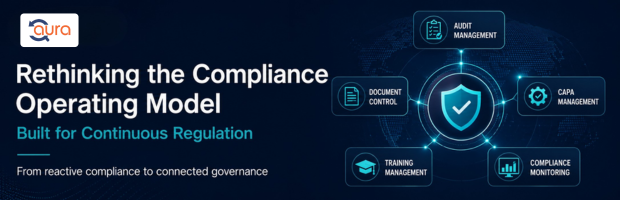
Audit management, document control, CAPA management, training management, and compliance monitoring should operate within a connected ecosystem rather than as independent activities.
Automate Routine Compliance Activities
Workflow automation reduces administrative effort while improving consistency, accountability, and response times.
Make Compliance a Leadership Metric
Compliance performance should be reviewed alongside operational, financial, and business metrics. When leadership has real-time visibility into quality and compliance, decision-making becomes faster and more informed.
Preparing for the Next Wave of Regulation
Regulatory complexity is expected to increase across manufacturing, healthcare, life sciences, automotive, and engineering sectors.
At the same time, organizations are exploring how analytics and AI can strengthen compliance monitoring by identifying trends, prioritizing risks, and improving decision-making. While these technologies continue to evolve, their success depends on one prerequisite: high-quality, connected data.
Organizations that continue operating with fragmented compliance information will find it increasingly difficult to respond to evolving requirements.
Those that invest in integrated digital quality management today will be better positioned to adapt tomorrow.
Key Takeaways
- Compliance is evolving from a reactive function to a continuous business capability.
- Enterprise-wide visibility is becoming a critical success factor.
- Integrated Digital Quality Management Systems improve governance, efficiency, and compliance readiness.
- Connected quality processes enable organizations to respond faster to changing regulatory requirements.
- The future of compliance belongs to organizations that build adaptive, intelligence-driven operating models.
Conclusion
The pace of regulatory change is unlikely to slow. Organizations that continue to rely on fragmented systems and periodic compliance activities will find it increasingly difficult to manage risk and demonstrate governance.
The next generation of compliance leaders will not be defined by how effectively they respond to regulations, but by how successfully they build organizations that are continuously prepared.
Rethinking the compliance operating model is no longer a transformation initiative—it is a strategic business imperative. By integrating audit management, CAPA management, document control, training management, and compliance monitoring into a connected Enterprise Quality Management strategy, organizations can strengthen resilience, improve operational performance, and create lasting competitive advantage.

