


Quality Management Software for Healthcare & Hospitals
Hospitals and healthcare organizations manage quality in a high-responsibility environment where patient safety, clinical governance, staff competency, SOP control, internal audits, incident follow-up, and compliance evidence must be handled with discipline.
AURA helps Quality Managers, Compliance Managers, Internal Auditors, ISO Consultants, Hospital Administrators, Department Heads, and Healthcare Quality Teams manage critical quality workflows from one centralized QMS platform.
With AURA, your team can manage clinical audits, document control, staff training records, CAPA actions, task ownership, dashboards, and role-based workflows in one connected system.
Built for healthcare teams that need stronger audit readiness, better SOP traceability, faster corrective action closure, and clearer compliance visibility without depending on spreadsheets, shared folders, paper records, or manual follow-ups.
Healthcare Quality Management Requires Control, Evidence, and Accountability
Healthcare quality is not limited to policy creation or periodic audits. Hospitals must show that processes are followed consistently across clinical, administrative, diagnostic, nursing, pharmacy, biomedical, housekeeping, infection control, and support service departments.
Every healthcare organization needs to manage a large volume of quality records, including clinical audit checklists, SOPs, staff training records, incident reports, CAPA records, policy review logs, equipment records, service records, infection control documents, and audit closure reports.
In many hospitals, these records are still managed through:
- Excel-based audit trackers
- Paper-based checklists
- Shared folders for SOPs and policies
- Manual training registers
- Email-based CAPA follow-ups
- Department-wise quality files
- Printed policy manuals
- Separate incident and audit records
- Manually prepared management review reports
This creates unnecessary risk during internal audits, external assessments, accreditation reviews, patient safety reviews, department audits, and leadership reporting.
AURA helps healthcare and hospital teams move from scattered quality records to a structured, centralized, and traceable QMS platform.
It is especially useful for organizations managing:
- Clinical audits
- Internal quality audits
- Department audits
- SOP and policy control
- Staff training records
- Incident follow-up
- CAPA and corrective actions
- Patient safety improvement actions
- Infection control documentation
- Equipment and service-related quality records
- Compliance dashboards and reports
- Management review evidence
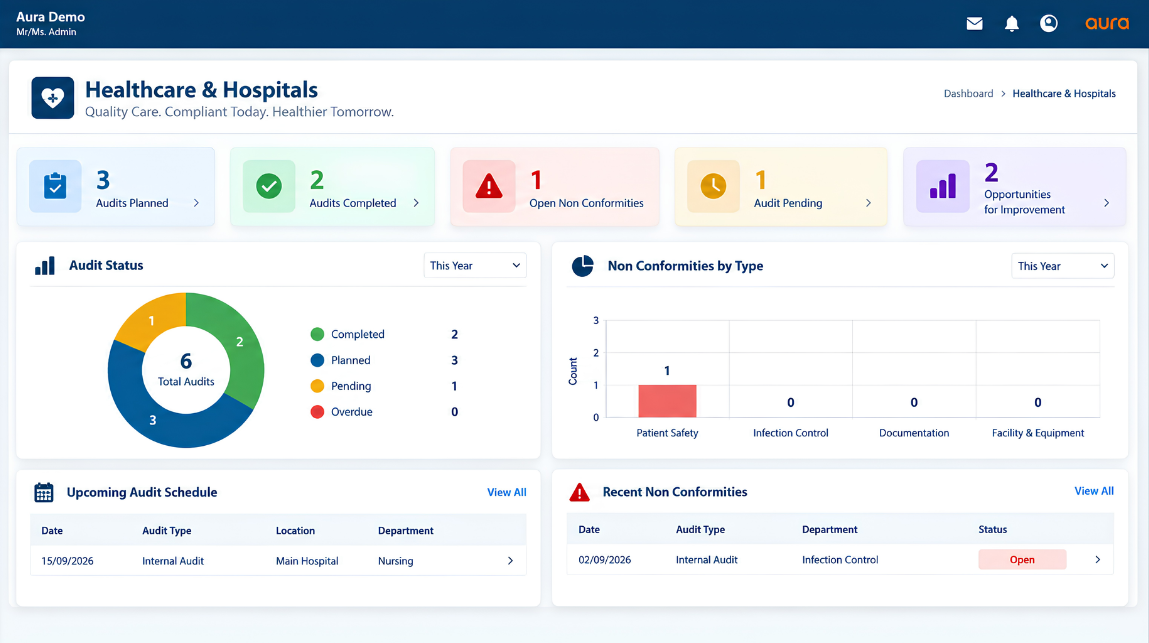
Real-Time Healthcare Quality Management Dashboard
AURA’s Healthcare Quality Management dashboard provides real-time visibility into clinical audits, corrective actions, staff training, SOPs, pending tasks, and compliance performance—helping healthcare teams identify gaps faster and maintain audit readiness.
Common Quality and Compliance Challenges in Healthcare & Hospitals
Clinical audit records are difficult to standardize
Hospitals run multiple clinical and non-clinical audits across departments. When each department uses a different format, tracker, or approval process, it becomes difficult to compare findings, track closure, and maintain consistent audit evidence.
SOP and policy control becomes fragmented
Healthcare teams depend on approved SOPs, clinical protocols, nursing procedures, administrative policies, infection control procedures, biomedical processes, emergency response instructions, and departmental guidelines. If outdated or uncontrolled documents remain in use, the risk of process variation increases.
Staff training evidence is hard to prove
Hospitals must frequently train clinical and non-clinical staff on updated SOPs, infection control practices, patient safety processes, quality procedures, emergency protocols, and department-specific requirements. When training records are maintained manually, gaps can remain hidden until an audit.
CAPA follow-up is delayed after audits or incidents
Audit observations, patient safety findings, infection control gaps, incident reviews, and process non-conformities require corrective action. Without clear ownership, due dates, reminders, and evidence tracking, CAPA closure may be delayed or incomplete.
Incident and quality records are scattered
Incident reports, investigation notes, corrective actions, training updates, policy changes, and audit references may sit in different files or departments. This makes it difficult for quality teams to demonstrate the full improvement cycle.
Department heads lack real-time visibility
Hospital leadership needs to know which audits are pending, which CAPA actions are overdue, which SOPs need review, and where training gaps exist. Manual reporting often gives this information too late.
Accreditation preparation becomes people-dependent
If audit history, policy status, training evidence, or corrective action follow-up depends on a few individuals, the hospital becomes vulnerable during staff changes, assessments, leadership reviews, or external audits.
How AURA Supports Healthcare & Hospital Quality Teams
AURA centralizes audit management, document control, training management, CAPA, task tracking, dashboards, and reporting into one web-based QMS platform.
Instead of managing hospital quality activities through separate spreadsheets, folders, registers, and emails, AURA helps teams create a connected workflow where records, responsibilities, approvals, actions, and evidence are easier to control.
Centralized Audit Management
Plan, schedule, assign, conduct, track, and close clinical audits, internal audits, department audits, infection control audits, service audits, and quality assessments. AURA helps teams manage audit checklists, observations, findings, non-conformances, evidence, and closure status.
Controlled Document Management
Manage SOPs, policies, protocols, forms, manuals, templates, quality records, department documents, and review logs with version control, approval workflows, access permissions, archiving, and document history.
Staff Training Management
Assign and track training based on department, role, SOP update, audit finding, incident learning, or compliance requirement. This helps hospitals maintain training evidence for audits, accreditation reviews, and management reporting.
CAPA and Task Tracking
Convert audit findings, incident observations, process gaps, or quality issues into corrective actions with defined owners, target dates, priority, evidence requirements, and closure tracking.
Real-Time Dashboards
Give Quality Heads, Compliance Managers, Department Heads, Hospital Administrators, and leadership teams visibility into audit status, open CAPA actions, pending document approvals, overdue tasks, and staff training completion.
Role-Based Access
Give users access based on responsibility. Quality teams, auditors, document owners, training coordinators, department heads, nursing teams, administrators, and leadership can work within controlled permissions.
Mobile Accessibility
Support distributed hospital teams and department-level follow-ups with mobile-friendly access where applicable. This helps users review tasks, respond to actions, and access quality information more efficiently.
Workflow Automation
Automate reminders, approvals, audit assignments, CAPA follow-ups, training notifications, escalations, document review alerts, and reporting workflows to reduce repetitive manual coordination.
Key AURA Features for Healthcare & Hospitals
| AURA Capability | Practical Benefit for Healthcare Teams |
|---|---|
| Audit Management | Plan audits, assign auditors, record findings, track observations, manage evidence, and close audits systematically. |
| Document Management | Control SOPs, policies, protocols, forms, manuals, templates, and quality records with version history and approvals. |
| Training Management | Assign and track staff training based on roles, departments, SOP updates, audit findings, and compliance needs. |
| CAPA Management | Track root cause, corrective actions, preventive actions, evidence, responsible owners, due dates, and closure status. |
| Assessment Management | Create clinical checklists, department assessments, clause-based reviews, and quality evaluation workflows. |
| Task Management | Assign quality actions to responsible users and monitor progress until closure. |
| Dashboard & Reports | View audit progress, pending tasks, overdue CAPA, document status, training gaps, and quality activity in real time. |
| Role-Based Access | Control who can create, review, approve, edit, close, or view quality records. |
| Customizable Workflows | Configure workflows around hospital departments, audit types, document categories, approval levels, and quality priorities. |
| Mobile-Friendly Access | Support department-level users, distributed teams, and timely quality follow-up. |
Business Benefits
Stronger audit and accreditation readiness
AURA helps hospitals organize audit schedules, checklists, evidence, findings, CAPA actions, document references, training records, and closure reports in one place.
Better SOP and policy traceability
Healthcare teams can reduce the risk of outdated procedures, uncontrolled documents, missing approvals, and unclear revision history.
Improved staff training compliance
Training records can be connected to roles, departments, SOP updates, audit findings, and patient safety improvement actions.
Faster corrective action closure
Automated reminders, task ownership, dashboards, and evidence tracking help reduce delays in CAPA completion.
Better department-level accountability
Department heads can view assigned actions, pending tasks, document responsibilities, and training gaps without waiting for manual reports.
Reduced manual workload for quality teams
Quality teams spend less time chasing updates, preparing reports, searching for records, and reconciling spreadsheets.
Clearer leadership visibility
Hospital administrators and quality leaders can review quality performance, audit progress, and compliance activity through structured dashboard views.
Why Healthcare & Hospital Teams Choose AURA
Unified Audit + Document + Training Platform
Many hospital quality gaps occur because audits, SOPs, policies, training records, and corrective actions are managed separately. AURA connects these areas so teams can trace activity from an audit finding to CAPA, document update, training assignment, and closure evidence.
ISO-Focused and Healthcare-Ready Workflows
AURA supports ISO-driven and compliance-heavy quality environments with structured audit planning, document control, training evidence, CAPA tracking, dashboards, role-based access, and audit-ready records.
Practical for Busy Healthcare Teams
Healthcare teams do not have time for complex tools that slow down daily work. AURA is designed to reduce manual follow-ups and support practical adoption across quality, clinical, administrative, and support departments.
Customizable for Hospital Departments
Every hospital has its own department structure, approval hierarchy, audit calendar, policy categories, training needs, and reporting requirements. AURA can be configured around these operating realities.
Scalable for Multi-Department and Multi-Location Healthcare Groups
AURA supports hospitals and healthcare groups that need centralized visibility while maintaining department-level ownership and location-wise accountability.
Affordable and ROI-Focused
AURA is suitable for healthcare organizations that want better quality control, audit readiness, and compliance visibility without heavy implementation complexity or excessive software cost.
Standards and Accreditation Areas Relevant to Healthcare Quality Teams
Healthcare organizations may operate under different accreditation, quality, safety, data security, and regulatory expectations depending on geography, services, ownership model, and clinical scope. AURA supports the workflows needed to manage audits, documents, training evidence, CAPA, task ownership, dashboards, and compliance records.
NABH Accreditation
For hospitals in India, NABH accreditation is a major healthcare quality and patient safety framework. AURA can help healthcare teams manage quality workflows such as clinical audits, SOP control, training records, incident follow-up, CAPA tracking, policy reviews, and management review evidence.
JCI Accreditation
For hospitals pursuing international accreditation, JCI standards focus on healthcare quality, patient safety, performance measurement, and continuous improvement. AURA can support structured audit evidence, document control, training records, CAPA follow-up, and quality improvement workflows.
ISO 9001
ISO 9001 is relevant for healthcare organizations that want a structured quality management system focused on process control, customer satisfaction, documented information, internal audits, corrective actions, and continual improvement.
ISO 7101
ISO 7101 is a healthcare-specific management system standard focused on quality in healthcare organizations. Healthcare providers can use AURA workflows to support documented processes, audits, corrective actions, and quality improvement activities.
ISO 15189
Hospitals with medical laboratories may need to consider ISO 15189, which defines requirements for quality and competence in medical laboratories. AURA can support supporting workflows such as document control, training records, audit evidence, corrective actions, and task tracking.
ISO/IEC 27001
Hospitals manage sensitive patient, employee, supplier, and operational information. Where information security management is part of the hospital’s scope, AURA can support audit, document, task, and training evidence related to quality and compliance workflows.
ISO 45001
Healthcare organizations may also need structured occupational health and safety workflows for staff safety, facility safety, incident follow-up, training, and corrective actions.
How Healthcare Teams Can Use AURA
Step 1: Define audit programs
Create audit schedules for clinical audits, internal audits, department audits, infection control audits, facility audits, service audits, or accreditation readiness reviews.
Step 2: Assign auditors and department owners
Define responsibility by department, process, location, service area, document category, or quality function.
Step 3: Select checklists and assessment templates
Use standardized checklists for clinical quality, nursing, infection control, pharmacy, diagnostics, biomedical, facility management, documentation, or department-level audits.
Step 4: Conduct audits and record findings
Capture observations, non-conformances, evidence, responsible owners, risk areas, due dates, and supporting comments.
Step 5: Assign CAPA and quality tasks
Convert findings into corrective actions with root cause, owner, target date, priority, evidence requirement, and closure status.
Step 6: Link relevant SOPs and policies
Attach or reference SOPs, policies, clinical protocols, manuals, forms, quality records, incident reports, or previous audit reports.
Step 7: Trigger staff training where required
Assign training when an SOP changes, an audit finding identifies a knowledge gap, an incident leads to process learning, or a department requires refresher training.
Step 8: Track progress through dashboards
Monitor open findings, overdue CAPA, pending document approvals, incomplete training, department-wise tasks, and audit closure status in real time.
Step 9: Review closure and effectiveness
Verify whether corrective actions addressed the root cause and whether additional action is needed to prevent recurrence.
Step 10: Maintain audit-ready evidence
Retain audit reports, CAPA records, SOP references, training records, incident follow-up evidence, policy review logs, and management review inputs for future audits and accreditation reviews.
Manual Process vs Other Software vs AURA
| Area | Manual Process | Other Standalone Software | AURA |
|---|---|---|---|
| Clinical Audit Planning | Paper checklists, Excel trackers, manual coordination | May support audit scheduling but may not connect with documents and training | Centralized audit planning, checklists, assignments, findings, CAPA, reminders, and closure records |
| SOP & Policy Control | Shared folders, printed SOPs, email approvals, unclear revision history | May store documents but may not connect them with training and audit workflows | Version control, approval workflows, access permissions, document history, and audit linkage |
| Staff Training Records | Paper attendance sheets, HR files, separate trackers | Training tracking may not link to SOP updates or quality findings | Training assignments and completion tracking linked to roles, departments, documents, and compliance needs |
| CAPA Tracking | Manual registers and email follow-ups | CAPA may exist as a separate module | Findings, root cause, corrective action, evidence, task ownership, and closure tracking in one workflow |
| Incident Follow-Up | Incident notes and actions scattered across departments | Incident tracking may not connect with training, SOPs, and CAPA | Quality actions can be tracked with document references, training needs, owners, and closure evidence |
| Accreditation Evidence | Evidence collected manually before reviews | Evidence may be stored module by module | Centralized evidence across audit, document, training, CAPA, and task workflows |
| Dashboards | Manual reports prepared after data collection | Limited or module-specific dashboards | Real-time visibility across audits, tasks, documents, training, and CAPA |
| Department Accountability | Follow-up depends on individuals | Ownership may be unclear across modules | Role-based ownership, task assignment, reminders, and dashboard visibility |
| Workflow Automation | High dependency on manual reminders | Automation varies by vendor | Reminders, approvals, escalations, assignments, document review alerts, and reporting workflows |
| Best Fit | Small teams with low compliance complexity | Hospitals needing one isolated function | Healthcare teams needing unified Audit + Document + Training Management |
FAQs
Bring Audit Readiness and Quality Control Into One Healthcare QMS Platform
If your hospital or healthcare organization is still managing audits, SOPs, staff training, CAPA, incident follow-ups, and compliance evidence through spreadsheets or disconnected systems, AURA can help you move to a more controlled and audit-ready workflow.
With AURA, your team can centralize quality records, automate follow-ups, improve SOP traceability, track training completion, close corrective actions faster, and give leadership real-time visibility into quality performance.
Book a personalized AURA demo for your healthcare quality team.

