

Internal auditors spend a lot of time recording their findings. The problem does not always lie with the audit itself; it can be the way in which the subsequent text is worded.
Even if an observation includes all the correct facts, it may still require clearer structure, improved grammar, or a more professional tone. In multilingual organizations, auditors might also have to communicate questions and answers in different languages.
Although AI can assist with these tasks, audit documentation has one essential requirement: the AI must improve the way the text is worded without altering the facts.
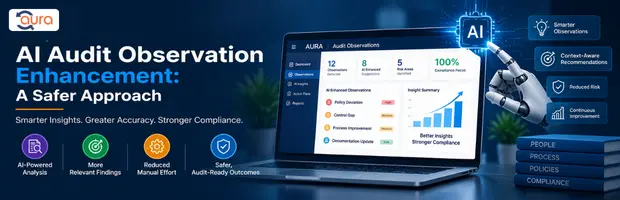
This is the principle behind the AI features of Aura V3 for drafting internal audit reports.
What Is AI Audit Observation Enhancement?
AI audit observation enhancement involves improving the clarity, grammar, structure, and professional tone of an observation while ensuring that the original facts are preserved.
That is not the same as asking AI to create an audit finding from scratch.
The responsibility for the observation remains with the auditor, while AI helps with the phrasing.
For instance, an auditor might produce an observation that correctly identifies a problem but is affected by inconsistent sentence structure or vague wording. An AI enhancement tool can improve that observation while allowing the auditor to examine both the original and suggested versions before deciding whether to accept the change.
This distinction is important in quality and compliance environments because documentation needs to remain traceable to what was actually observed.
Common Challenges in Audit Documentation
Inconsistent Observation Wording
The same auditors might describe similar observations in entirely different ways.
One observation can be brief and well organised, whereas another might include unnecessary words or grammatical errors. Although this does not necessarily mean there is a difference in audit quality, it can make reports more difficult to review consistently.
AI-assisted enhancement can help address the writing issue without altering the original observation.
Time Spent Editing Audit Text
Auditors should concentrate on evidence, controls, process performance, and their findings. Constantly proofreading and reworking observations can result in unnecessary administrative effort.
Instead of having to rewrite the observation manually, an AI writing assistant can offer a refined version for review.
Language Barriers
Organizations with operations in more than one location may conduct audits involving people who work in different languages.
While translating an audit question or answer may help participants understand the content, the translation should not replace the original English observation or result in an uncontrolled alteration of the audit record.
How Responsible AI Can Support Audit Work
AI is most useful when it assists the auditor rather than making decisions on the auditor’s behalf.
A practical workflow looks like this:
- The auditor writes the observation.
- The AI reviews the existing text.
- The AI produces an enhanced version.
- The auditor examines the original version and the revised text.
- The auditor decides whether to replace the original.
- The system records AI usage.
Human judgment remains part of the workflow.
The AI assists with language rather than determining whether something is a finding, creating evidence, or altering what actually happened.
How Aura’s AI Enhancement Works
Aura V3’s AI Enhancement feature is intended for use with a single audit observation on the draft-report screen.
It can help improve:
- Grammar
- Clarity
- Structure
- Professional tone
The aim of the enhancement is to preserve the facts contained in the original observation.
The auditor maintains control by using an explicit Replace action. Additionally, the workflow includes Refine, Undo, and Redo features, which allow the auditor to examine and manage changes rather than automatically accepting an AI-generated version.
The use of AI is also recorded, providing clearer visibility into how the capability is being used.
Why Explicit Replacement Matters
An AI system must not quietly replace the auditor’s original wording.
When the original and suggested versions are kept separate during review, the auditor can verify that the revised text still accurately reflects the observation.
This is especially important because the audit documentation may later be examined by quality managers, compliance teams, or other stakeholders.
AI Translation for Multilingual Audit Workflows
Translation poses a different challenge from improving an observation.
An audit question and/or answer might need to be translated into a chosen target language, and Aura’s AI Translator has been developed to assist with this aspect of the auditing process.
The workflow includes:
- From and To language selection
- Target-language selection
- Location-based default language
- Automatic translation
- Reuse of stored translations where available
- Configured provider fallback when required
- Separate display of translated output
The English observation is not overwritten by the translated output.
Keeping the two versions separate is important because the original-language record remains available, while the translated version enables communication with people taking part in the audit.
Why Human Review Still Matters
AI-generated text should be reviewed before it is included in an audit record.
A responsible workflow should consider:
- Does the improved observation still refer to the same event?
- Has a fact been added or removed?
- Has the meaning changed?
- Does the translation faithfully reflect the original?
- Is the phrasing suitable for the purpose of an audit?
The aim of using AI assistance is to reduce the work required for writing and translation while keeping the auditor in control of the final output.
Manual vs AI-Assisted Audit Documentation
| Manual Approach | AI-Assisted Approach |
|---|---|
| Auditor edits wording manually | AI suggests wording improvements |
| Grammar corrections take additional time | Grammar and structure can be refined |
| Translation may require separate tools | Translation is available within the workflow |
| Original and revised wording may be difficult to compare | Original and AI output can be reviewed |
| AI activity may be outside the QMS | AI usage can be recorded within the system |
The need for audit judgment is not eliminated by the use of AI. Instead, some of the work involved in administrative writing is shifted.
What to Look for in AI Audit Software
When organisations are assessing AI for use in audit documentation, they should not just consider whether a product has an AI button.
Consider these questions:
Does the AI retain the original facts?
The system should be designed to improve the wording without making up any findings or evidence.
Can the auditor review before replacing the original?
It is important to have explicit human approval when AI-generated text is included in controlled documentation.
Is AI activity traceable?
Organizations may need the ability to see when AI capabilities are being used and how the suggestions are handled.
Is tenant authorization enforced?
The AI features of Enterprise should adhere to the same access restrictions as the underlying QMS.
Does the translation process retain the original record?
The translation should enable communication without quietly replacing the original audit observation.
The importance of these controls goes beyond simply describing a feature as “AI-powered.”
What Aura’s AI Audit Workflow Does Not Currently Claim
Responsible use also means being clear about the limitations.
The current Aura AI feature scope does not include:
- Report-wide translation UI
- Persistence of an accepted translation as a separate finalized workflow
- A dedicated approval workflow for AI translations
- Bilingual submitted reports
- Automatic source-language detection
Although these limitations do not prevent AI from assisting with individual observations and translation, they define the current scope of the workflow.
Final Takeaway
AI can help with the preparation of audit documentation without removing responsibility from the auditor.
The practical application is simple: it helps auditors improve their wording, reduce repeated editing, and enable communication across different languages without losing the original facts or removing human review from the process.
For quality and compliance teams, that distinction is important. AI should help produce the audit record, not act as the one making the audit decision.

