

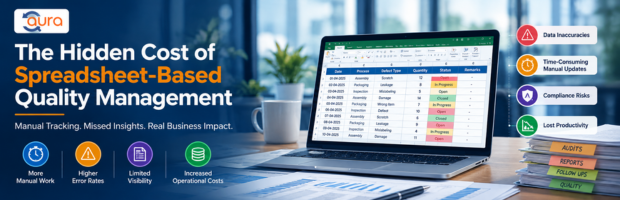
Spreadsheets almost never become a major technology decision when they enter a quality department. Instead, they typically appear as a practical solution to a small operational issue, such as tracking an audit, monitoring corrective actions, managing training records, or preparing a report.
Trouble arises when the spreadsheet becomes incorporated into the organisation’s control system.
In regulated companies, the cost of using spreadsheets for quality management is usually concealed in employee time, duplicate records, the need to reconcile versions, evidence gathering, delayed follow-ups, and the preparation of management reports. AURA Quality Management believes that the business case for digital quality governance should therefore be assessed not just on the basis of software cost, but also in terms of the operational effort required to maintain a fragmented manual system and keep it reliable.
About the Issue
Spreadsheet-based quality management usually develops gradually.
One group sets up an audit tracker, another looks after the CAPA register, and the quality manager has a separate document-review list. Training records are kept in a different workbook, with evidence spread across shared folders and email.
Each of these tools might function by itself.
The problem arises when teams need to connect them.
A quality leader might have to determine whether a repeated audit finding is related to an overdue CAPA. An auditor might need to check whether a revised procedure led to employee training. Management might want a consolidated view of open quality actions across several locations.
The information may exist.
But it can take a good deal of manual work to find, reconcile, and validate it.
That is the hidden cost.
AURA has already identified fragmented spreadsheets, emails, and manual follow-ups as causes of delayed audit cycles, limited compliance visibility, inconsistent reporting, and weak accountability.
The wider problem goes beyond audit administration; it is about how an enterprise manages quality information.
Why This Matters to Enterprise Quality Teams
For a small operation, manually maintained trackers might be manageable.
In a regulated company with multiple departments, facilities, suppliers, and processes, the amount of administrative work can increase rapidly.
The 2025 study carried out by the Institute of Internal Auditors shows that there is a wider technology gap. According to its Pulse of Internal Audit report, 92 per cent of respondents identified data analytics as the most important technological skill for the future of internal audit, whereas only 28 per cent said that they had high or advanced levels of data analytics use in their departments.
Another 2025 study by the IIA and Baker Tilly showed that almost 60% of respondents continued to use word-processing files and spreadsheets for enterprise risk management, whereas 21% used a dedicated GRC platform.
These findings do not establish that spreadsheets are unsuitable for all types of quality work. What they do show, however, is that many organisations still rely on simple tools even as they expect quality and risk functions to provide increasingly sophisticated visibility.
This results in a gap between the information that organisational leadership requires and the information that existing systems produce.
The First Hidden Cost: Duplicate Work
One of the first costs associated with using spreadsheets for quality management is duplication.
Information might need to be entered into several files or passed between different teams.
For example:
Audit finding → CAPA tracker → department tracker → management report
Every transfer introduces another opportunity for:
- Data-entry errors
- Missing information
- Outdated status
- Inconsistent terminology
- Duplicate records
- Delayed updates
As a result, the quality team spends time checking the information rather than working on improving the process that produced it.
It is important to make this distinction when calculating the actual cost of manual quality management.
The question should not simply be:
What is the cost of the spreadsheet system that we are currently using?
It should be:
How much time does the organisation spend maintaining, reconciling, validating, and reporting the information within that system?
The Second Hidden Cost: Version Confusion
Quality management places a great deal of importance on controlled information.
Documents are subject to change. Procedures are altered. Audit checklists are amended. Corrective actions can lead to new requirements. Training might have to be aligned with a document revision.
It becomes a regular administrative task to determine which version is current when information is spread across spreadsheets, email attachments, shared drives, and local folders.
This creates a simple but important governance problem:
Which record should management trust?
The answer should not depend on asking several people which spreadsheet was updated most recently.
A well-organised quality environment establishes controlled ownership, access, revision history, and traceability to support the quality process.
The product architecture of AURA covers document management features such as versions, approvals, access control, and change history, as well as audit, training, CAPA, assessment, task, dashboard, and reporting functions.
The Third Hidden Cost: Delayed Follow-Up
A spreadsheet can show that an action is overdue.
It does not mean that someone will act on it.
In manual situations, follow-up might rely on emails, meetings, personal reminders, or periodically checking the tracker.
The more actions there are, the more the quality team has to take on the job of coordinating the coordination process.
This can affect:
- CAPA closure
- Audit actions
- Document reviews
- Training completion
- Evidence submission
- Management-review preparation
The result is a paradox: the more time quality teams spend controlling the system that is meant to assist them in maintaining quality, the more time they spend on that administrative control.
The Fourth Hidden Cost: Audit Evidence Preparation
There is another way to measure the cost: through audit preparation.
The problem is usually not that an organisation lacks evidence.
The issue is that evidence can be spread across several sources.
An auditor may request evidence relating to a finding, and the quality team may need to locate:
- The original audit record
- The finding
- The assigned corrective action
- Root-cause information
- Supporting evidence
- The revised document
- Related training records
- Effectiveness verification
- Closure approval
It can take considerable time to put together the full evidence trail if the records are kept separately.
The time involved should form part of the cost of the quality process.
The Fifth Hidden Cost: Management Reporting
There is an increasing expectation that quality leaders should give management clear information regarding their compliance performance.
Creating a management report from a series of separate spreadsheets can turn into merely a reporting exercise rather than a true management exercise.
Teams may need to:
- Consolidate department-level trackers
- Remove duplicate records
- Check status changes
- Validate overdue actions
- Reconcile audit findings
- Prepare charts
- Confirm figures with process owners
Management cannot review the information until this work has been completed.
As a result, there is a delay between the actual operational situation and what leadership is able to see.
By providing a structured digital environment, this gap can be reduced because reporting can become part of the quality workflow rather than remain a separate administrative task.
What Spreadsheet Dependency Does to Audit Defensibility
Audit defensibility requires more than simply keeping records.
An organisation may need to demonstrate:
- What requirement applied
- What was assessed
- What was found
- Who owned the response
- What action was taken
- What evidence supported the action
- When the action was completed
- Whether the action was effective
If those elements are connected, the audit trail becomes easier to understand.
If the information is fragmented, the organisation might have to reconstruct the story manually.
This distinction is particularly important when quality teams operate across multiple departments or locations.
The issue is not necessarily that the information is missing, but that the organisation may be unable to retrieve and connect it efficiently enough to demonstrate control with confidence.
The Business Case for Digital Quality Governance
The transition from using spreadsheets to adopting digital quality governance should not be justified merely on the grounds that it is a software upgrade.
It should be regarded as a decision concerning the way the organisation operates.
A structured digital environment can help organisations establish:
Controlled Information
Quality records, documents, evidence, and actions can be managed using established processes instead of individual files.
Clear Accountability
Within the workflow, owners, deadlines, approvals, and action status become visible.
Traceability
Audit findings, corrective actions, documents, training, and supporting evidence can be linked.
Consistent Reporting
Management information can be obtained from the same operational records used by quality teams.
Lower Administrative Overhead
The time needed to reconcile spreadsheets, look for evidence, and manually combine reports can be reduced.
Stronger Governance
Leadership can gain a better view of the status and direction of quality and compliance activities.
The objective is not to get rid of spreadsheets across the enterprise.
The aim is to stop using them as the main means of controlling processes where traceability, accountability, version control, and evidence are important.
How to Calculate the Hidden Cost
A simple time analysis can serve as the starting point for a practical business case.
Track the number of hours spent each month on:
| Quality Activity | Measure |
|---|---|
| Audit planning and scheduling | Hours per month |
| Evidence collection | Hours per audit |
| Audit report consolidation | Hours per audit |
| CAPA follow-up | Hours per month |
| Spreadsheet reconciliation | Hours per month |
| Document-version verification | Hours per month |
| Training-record reconciliation | Hours per month |
| Management-review preparation | Hours per reporting cycle |
The calculation can then be applied to all the people involved.
Annual manual administration cost = total annual hours × fully loaded hourly labour cost
For example, if the quality, operations, and department teams together spend 250 hours each month on spreadsheet administration and reconciliation, this amounts to 3,000 hours per year before considering the effects of delays, errors, repeated work, or compliance exposure.
This calculation is not based on the idea that each hour will disappear as a result of digitisation. Its aim is to establish a benchmark against which the organisation can assess the resources used by manual quality processes.
Measuring the Value of the Change
A more robust business case for digital quality should also take outcomes into account.
Relevant metrics include:
- Audit preparation hours
- Evidence retrieval time
- CAPA follow-up hours
- Overdue CAPA rate
- Repeat finding rate
- Document-review completion
- Training reconciliation time
- Management-report preparation time
- Time spent reconciling quality records
These measures link technology investment with operational performance.
They also enable executives to assess quality improvement in terms of business value rather than viewing it only as an IT expenditure.
What Quality Leaders Should Ask
Before expanding another spreadsheet-based quality process, leaders should ask:
- How many individual trackers are being used for quality and compliance?
- How much time is spent reconciling them?
- Is it possible to trace a finding through the CAPA process, the evidence, the effectiveness review, and to closure?
- Can the organisation find overdue actions across different departments without having to ask for separate reports?
- Can document changes be linked to related training needs?
- How much time is spent preparing audit evidence?
- How much management time is used to bring quality information together?
- Which manual process presents the greatest risk of failing to identify missing, outdated, or inconsistent information?
The answers provide a clearer picture of whether spreadsheets are still supporting the quality function or whether they are beginning to restrict it.
About AURA Quality Management
AURA Quality Management offers digital quality management software designed to assist organisations in managing audits, documents, training, assessments, tasks, dashboards, supplier activities, and compliance workflows. The overview of its product lists features available in the areas of internal audits, document control, training records, CAPA tracking, task management, dashboards, and compliance reporting.
AURA’s target customers are quality leaders, compliance managers, internal auditors, CIOs, and operations executives who work in quality-driven and regulated environments. The ideal customer profile encompasses medium-to-large organisations in the manufacturing, healthcare, pharmaceutical, automotive, and regulated services sectors that are making the move from manual processes to digital quality management.

