

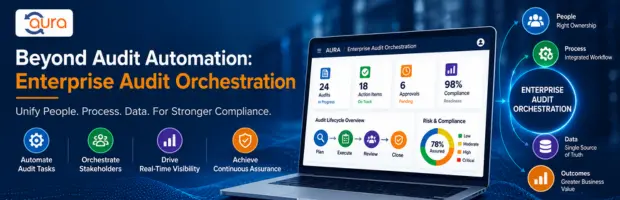
Audit automation has addressed a major issue for enterprise quality teams: the administrative work involved in scheduling audits, assigning responsibilities, monitoring findings, and following up on corrective actions.
The next problem is more difficult.
As organisations grow in terms of departments, facilities, suppliers, and the variety of regulatory requirements, automating individual audit tasks does not necessarily enable leaders to determine where audit resources should be directed, which risks need to be addressed, or how audit performance influences business operations.
This is where enterprise audit orchestration becomes relevant.
It represents a shift from automating activities to organising the entire audit operating model around risk, resources, accountability, and business performance.
About the Shift
A scheduled audit workflow can arrange an audit, notify the auditor, assign a checklist, record findings, and send reminders.
Those capabilities matter.
An enterprise audit programme involves more than simply transferring tasks from one person to another.
Quality and internal audit leaders also need to consider:
- Which processes pose the greatest risk?
- In which locations are similar findings being observed?
- Which departments have unresolved actions?
- How should limited auditor capacity be distributed?
- Which findings require management attention?
- What impact are audit results having on operational performance?
- What should be prioritised in the following audit cycle?
These questions require information from different sources to be brought together.
AURA’s current audit-management positioning includes the ability to carry out audit planning and scheduling, assign auditors and auditees, select checklists, manage findings, track corrective actions, and provide real-time reporting.
The opportunity is to incorporate these capabilities into a more comprehensive management model rather than viewing each activity as a separate workflow.
Why Automation Alone Is Not Enough
Although automation and orchestration are connected, they address different problems.
Automation asks:
What can we do to make this task take place with less manual work?
Orchestration asks:
How should these various activities work together to achieve the organisation’s audit and risk objectives?
For instance, an automated scheduling system can schedule an audit according to a predetermined calendar.
A more coordinated audit programme could also take into account past findings, overdue CAPAs, department performance, location-level trends, auditor availability, and changes in risk when deciding where to focus attention.
The larger organisations become, the more important that distinction becomes.
A process that can handle five departments might prove difficult to manage when there are 50 departments or several plants.
Connecting Audit Planning with Risk
A major change in enterprise audit management is the link between audit planning and risk.
Traditionally, planning begins with a calendar.
A more mature approach begins by asking questions about exposure.
Previous findings can serve as one indicator, while CAPA performance can provide another. Further context can be obtained from changes in processes, locations, suppliers, regulatory requirements, or operational performance.
This creates the possibility of a more dynamic planning model:
Risk signals → priority areas → audit resources → audit execution → findings → corrective actions → performance insight
The value comes from linking the different stages.
When drawing up the next audit programme, information about repeated findings and several overdue corrective actions should be available.
Similarly, if a department has demonstrated a consistent record of strong performance, audit resources might be allocated differently.
The aim is not to eliminate scheduled audits but to ensure that planning is based on more accurate information.
From Auditor Scheduling to Resource Allocation
Automation on its own may not be enough when it comes to auditor capacity.
The resources available to enterprise audit teams are usually limited. The problem does not consist merely of assigning an auditor to an available time slot; it lies in matching the right level of expertise and capacity with areas that pose a risk.
An enterprise audit-management approach should therefore help leaders consider:
- Auditor availability
- Auditor competency
- Audit scope
- Location requirements
- Process complexity
- Risk level
- Previous findings
- Audit frequency
- Outstanding corrective actions
This makes scheduling part of resource planning.
The difference can be considerable.
A calendar tells an organisation when an audit is taking place.
Resource orchestration can explain why that audit is a priority and whether the appropriate resources have been allocated to it.
Findings Should Trigger Action, Not Another Tracker
The audit itself is only one stage of the process.
When a finding is raised, the organisation needs clear ownership, deadlines, evidence, corrective action, verification, and closure.
In manual systems, this often creates a second administrative layer. Findings are entered into CAPA trackers, emails are sent to responsible parties, requests for status updates are made, and management reports are manually compiled.
A structured workflow can link these activities.
For example:
Finding → owner → corrective action → due date → evidence → verification → closure
The value is not simply fewer emails.
It is the creation of a traceable chain of accountability.
AURA’s product overview presents audit scheduling, document control, training management, corrective-action workflows, dashboards, and audit traceability as connected elements of its quality management approach.
Collaboration Is Part of Audit Performance
Audit management is generally regarded as the auditor’s responsibility.
In practice, several groups take part in an audit.
- Auditors assess.
- Auditees provide evidence.
- Process owners address findings.
- Quality teams monitor corrective actions.
- Department leaders provide resources.
- Executives review significant risks.
The audit process can become fragmented if these groups work from separate information.
Collaboration should therefore be supported by enterprise audit orchestration without reducing accountability.
Everyone should be able to understand the part they own:
- The auditor sees assigned audits and findings.
- The auditee sees the required evidence and actions.
- The process owner sees responsibilities and deadlines.
- Quality leadership sees overall audit status.
- Executives see material risks and trends.
A common operational view can be achieved without losing role-based responsibility.
Real-Time Reporting Has Executive Value
Reporting is usually regarded as the last stage of an audit.
It should also provide continuous information for executives.
A useful audit dashboard should answer more than:
How many audits have been carried out?
Leadership may also need to know:
- How many audits are currently in progress?
- Which findings remain open?
- Which actions are overdue?
- In which areas are repeated findings appearing?
- Which departments require attention?
- Where are the open issues most numerous?
- What is the trend in audit performance over time?
AURA’s audit-management materials describe real-time tracking of audit progress, findings, pending actions, closure status, and reports.
The value for executives lies in using this information to make decisions rather than simply preparing another monthly report.
Industry Context
The requirement for better audit orchestration is part of a wider shift in enterprise governance.
Organisations now operate across multiple locations, work with various suppliers, have several business units, and must comply with different regulatory frameworks. As a result, quality teams need to handle greater amounts of information while still keeping their audit procedures consistent.
The Global Internal Audit Standards issued by the Institute of Internal Auditors regard internal auditing as part of the wider field of governance, risk management, and control. Therefore, the information produced by audits has value beyond simply showing that an audit has been carried out.
It enables managers to see where controls are effective, where weaknesses continue to occur, and where it may be necessary to allocate resources.
This is in keeping with the approach reflected in AURA’s recent content, where administrative auditing, standardised auditing, audit automation, and more data-driven audit intelligence are distinguished.
The next stage is to get those stages working together operationally.
What Enterprises Should Expect from an Advanced Audit System
When companies are assessing audit technology, they should not stop at a list of automated tasks.
The more useful questions concern operating capability.
1. Can the system link planning with risk?
Audit planning should be based on relevant findings, corrective actions, performance trends, and organisational priorities.
2. Can it support audit capacity planning?
It should assist leaders in understanding auditor availability, responsibilities, scope, and workload.
3. Can results lead to accountable action?
Corrective action should not require manual entry into another tracking system simply to begin.
4. Can various stakeholders participate in the same process?
Auditors, auditees, quality teams, process owners, and management require different views of the same underlying information.
5. Can executives see the current position?
Reports should provide up-to-date visibility into audit progress, findings, overdue actions, and ongoing issues.
6. Can historical information influence future planning?
Previous findings should not be lost in archived reports. Instead, they should be used for future risk assessments and audit planning.
These are the features that distinguish task automation from audit orchestration.
Measuring the Business Impact
Any organisation considering transformation of its audit process should measure performance both before and after making changes to the workflow.
A useful comparison can include:
| Measure | Before Digital Workflow | After Digital Workflow |
|---|---|---|
| Audit planning time | Baseline hours | New average |
| Finding closure time | Baseline days | New average |
| Report preparation | Baseline hours | New average |
| Overdue actions | Baseline rate | New rate |
| Evidence collection | Baseline hours | New average |
| Management reporting | Baseline effort | New effort |
The objective is not to assume that automation will improve every metric.
The aim is to obtain concrete evidence showing whether the new way of operating is reducing administrative work, enhancing accountability, and providing management with better information.
For AURA’s target organisations—enterprises in the manufacturing, healthcare, pharmaceutical, automotive, and regulated services sectors that are mid-sized or large—this kind of measurement can also be used to link quality improvement with operational priorities.
The Executive Takeaway
Automation in the context of audits plays an important role in reducing manual work.
Enterprises should be careful not to regard automated tasks as equivalent to an intelligent audit operating model.
The real issue is whether audit information can move around the organisation in a connected manner, from risk identification and planning through resource allocation, execution, findings, corrective action, and finally to executive reporting.
That is what audit orchestration entails.
For Quality Heads, it means better control of audit priorities.
For Internal Audit Managers, it means clearer insight into workload, findings, and follow-up actions.
For CIOs, it means a more structured digital workflow that links audit information with wider quality processes.
For Operations leaders, it means viewing audit results as information about how well processes are performing rather than simply as compliance records.
The next generation of audit management will therefore be judged not just by the number of manual tasks it automates, but by how well it assists the organisation in deciding where to focus, who needs to take action, and what management needs to know.
About AURA Quality Management
AURA Quality Management offers digital quality management software aimed at organisations that carry out audits, manage documents, provide training, conduct assessments, handle tasks, maintain dashboards, oversee supplier activities, and manage compliance workflows.
AURA’s product overview includes details about its capabilities in the areas of internal audits, document control, training records, CAPA tracking, task management, dashboards, and compliance reporting.
The intended users are quality leaders, compliance managers, internal auditors, CIOs, and operations leaders within mid-sized and large organisations in the manufacturing, healthcare, pharmaceutical, automotive, and regulated services sectors.

