

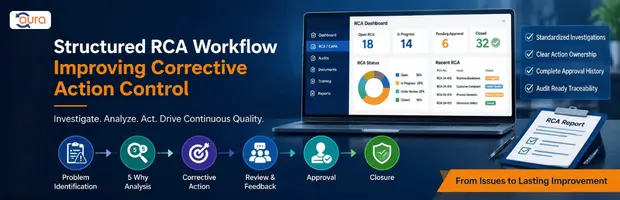
Quality teams are generally able to identify when a problem occurs. The greater challenge lies in ensuring that the investigation, corrective action implementation, approval, and closure processes are controlled and traceable.
A root cause analysis may be carried out due to a customer complaint, production deviation, audit finding, or process failure. However, many organizations continue to conduct their investigations using spreadsheets, emails, and manually updated trackers.
This creates common challenges:
- Different investigation methods are used by different teams.
- Responsibility for corrective actions is unclear.
- Review feedback is difficult to track.
- Rejected investigations may not have proper history.
- Closure decisions may not have complete approval records.
A structured root cause analysis process enables organizations to move from a reactive approach to controlled quality improvement by defining investigation stages, responsibilities, review requirements, and closure criteria.
What Is a Root Cause Analysis Process?
A root cause analysis process is a systematic approach used to identify the actual reason behind a problem and implement corrective actions to prevent recurrence.
Rather than only addressing visible symptoms, RCA focuses on understanding why the problem occurred.
A typical RCA process includes:
- Identifying the problem.
- Recording symptoms and operational observations.
- Investigating possible causes.
- Applying analysis techniques such as 5-Why analysis.
- Creating corrective actions.
- Reviewing and approving the solution.
- Verifying effectiveness.
- Completing formal closure.
For organizations that place a strong emphasis on quality, root cause analysis is not merely a problem-solving exercise. It is a structured process that supports compliance, encourages continuous improvement, and improves operational reliability.
Common Challenges in Root Cause Analysis
Inconsistent Investigations
Different departments often investigate problems using different methods.
For example, the manufacturing team may record production defects differently from how the quality team handles customer complaints.
Without an established RCA process, organizations may struggle to compare issues, identify trends, and maintain consistent quality practices.
Unclear Ownership of Corrective Actions
RCA usually involves multiple stakeholders:
- Quality teams
- Process owners
- Production managers
- Engineering teams
- Compliance teams
Corrective actions may remain open when ownership is unclear because no specific individual has been assigned responsibility.
By assigning responsible individuals and tracking pending actions, a structured RCA system improves accountability.
Limited Investigation History
Quality teams often need to answer important questions during audits:
- Who reviewed the investigation?
- Why was an action rejected?
- What feedback was provided?
- Who approved closure?
Without controlled records, maintaining complete investigation history becomes difficult.
Weak Closure Control
Assigning corrective actions does not mean that an RCA has been completed.
Effective closure requires confirmation that:
- Actions were completed.
- Reviews were performed.
- Approvals were recorded.
- The issue was properly closed.
Why Traditional RCA Methods Fail
Organizations often begin with spreadsheets because they are familiar and easy to use. However, as the number of investigations increases, manual tracking becomes difficult to manage.
| Manual Approach | Structured RCA Workflow |
|---|---|
| Spreadsheet-based tracking | Centralized RCA workflow |
| Email reminders | Automated notifications and status visibility |
| Limited ownership tracking | Role-based responsibility |
| Difficult revision history | Complete investigation records |
| Informal approvals | Controlled review and sign-off |
Although spreadsheets can store information, they do not enforce process discipline.
Even when a quality manager knows that an investigation is underway, manual systems do not ensure that it moves through investigation, review, approval, and closure stages in a controlled manner.
How Structured RCA Software Improves Corrective Action Management
Modern RCA software enables organizations to manage quality problems through a defined lifecycle.
The objective is not simply to convert paper forms into digital records. It is to establish a controlled workflow where all stakeholders understand their responsibilities.
Problem Identification and Investigation
A structured RCA workflow allows teams to capture:
- Problem descriptions
- Symptoms
- Gemba observations
- Investigation details
This helps teams distinguish between facts and assumptions before determining the root cause.
5-Why Analysis and Root Cause Identification
The 5-Why technique enables teams to move beyond symptoms and identify underlying process failures.
Example:
Problem: Faulty components were produced.
Why 1: Machine settings were incorrect.
Why 2: Parameter checks were overlooked.
Why 3: Responsibility for verification was unclear.
Why 4: Standard operating controls were not properly defined.
The objective is not to ask “Why?” exactly five times in every situation. The objective is to identify a meaningful cause that helps prevent the problem from happening again.
Corrective Action Ownership and Approval Control
A strong RCA process connects findings with corrective actions that have:
- Assigned owners
- Target dates
- Clear expectations
- Review visibility
A controlled RCA approval process allows reviewers and approvers to provide feedback, record rejection reasons, and maintain complete investigation history.
This improves transparency and ensures that decisions are not lost in emails or separate documents.
How Aura RCA Supports a Controlled RCA Lifecycle
Aura RCA follows a structured quality issue lifecycle:
Create → Assign → Acknowledge → Investigate → Review → Approve → Closure → Closed
The workflow supports different roles, including:
- Creator
- Owner
- Reviewer
- Approver
- Auditor
The owner can record symptoms and observations captured at the Gemba, redefine the problem, complete a 5-Why analysis, and create corrective actions with assigned owners and target dates.
Reviewers and approvers can provide feedback through controlled rejection routes, ensuring that comments and decisions remain part of the investigation history.
The process enables quality teams to maintain visibility from the initial identification of a problem through to final closure.
Best Practices for Effective RCA Management
1. Standardize Investigation Methods
Define when teams should use:
- 5-Why analysis
- Fishbone analysis
- Process reviews
- Data-based investigations
Consistency improves investigation quality.
2. Assign Clear Responsibility
Every corrective action should have a responsible person assigned.
Avoid assigning actions only to departments without identifying individual accountability.
3. Separate Root Cause Analysis From Action Planning
Before deciding how to fix a problem, teams should understand why it occurred.
Corrective actions taken too early may focus on treating symptoms rather than addressing the actual cause.
4. Maintain Complete Records
A strong RCA process should preserve:
- Review comments
- Approval decisions
- Rejection reasons
- Closure records
This supports audit readiness and improves process transparency.

