

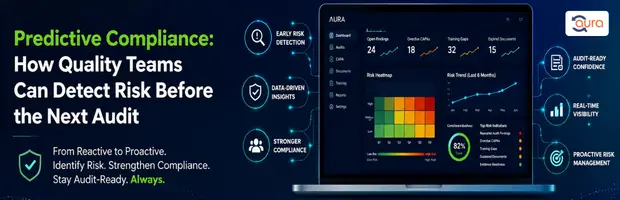
AURA Quality Management is drawing attention to a growing trend in enterprise quality management: the transition from periodic audit readiness to predictive compliance. The company states that quality teams operating in regulated and ISO-driven sectors must detect risk signals earlier by connecting audit findings, CAPA trends, training gaps, document-control delays, and compliance evidence into one comprehensive operational view.
About the Announcement
This situation reflects a wider shift in the way quality and compliance leaders are dealing with internal audits. In many organisations, audits continue to function as planned control checks. Teams prepare records, review past findings, collect evidence, and respond when nonconformities are found.
That model is coming under increasing pressure.
In sectors such as manufacturing, healthcare, pharmaceuticals, automotive production, engineering, and regulated services, compliance risk rarely appears without warning. It typically develops through operational indicators such as repeated findings, overdue corrective actions, incomplete training, out-of-date procedures, delayed document approvals, or poor evidence trails.
AURA believes these indicators should not be left scattered across spreadsheets, emails, shared folders, and departmental trackers. Instead, they should be treated as early-warning signs that enable leaders to understand where compliance exposure is developing before the next audit takes place.
Why This Matters
Predictive compliance alters the role of the quality function.
Rather than asking whether the organisation is ready for the next audit, quality leaders begin to ask whether the organisation can identify risk before it has to be revealed by an audit.
That distinction is important. Traditional audit readiness is based on specific events, while predictive compliance is continuous. It provides quality heads, compliance managers, internal auditors, and operations leaders with a clearer understanding of where process discipline is deteriorating.
For enterprises that operate across multiple departments or locations, the effects can be considerable. A recurring finding at one plant might be an isolated problem. If the same finding occurs at several sites, it could point to a fundamental weakness in the control system. An overdue CAPA could simply be a task delay. However, several overdue CAPAs related to the same process may point to a more serious governance issue.
The value of predictive compliance lies in identifying those signals before they turn into formal audit failures.
Key Highlights
- Predictive compliance identifies risk by using operational quality data.
- Key indicators include repeated audit findings, overdue CAPAs, ineffective corrective actions, training gaps, out-of-date documents, and delayed evidence submission.
- Quality teams can apply risk heatmaps to prioritise departments, locations, or processes with increasing compliance exposure.
- CIOs and IT managers are increasingly involved in connecting audit, document, training, CAPA, and reporting systems.
- This change enables more effective management reviews by giving executives real-time visibility into risk patterns rather than relying only on static audit summaries.
- Predictive compliance does not replace internal audits. It enhances them by making audit planning more risk-focused and evidence-based.
Industry Context
Timing is important because organisations guided by ISO standards and regulatory requirements are now expected to provide greater assurance around traceability, accountability, evidence availability, and management visibility.
ISO regards ISO 9001 as a quality management standard used in sectors such as manufacturing, healthcare, technology, construction, education, and public administration. ISO also states that management-system audits enable organisations to verify that their achievements conform to objectives and demonstrate compliance with standards.
Meanwhile, risk and compliance functions are moving toward more continuous forms of monitoring. According to Deloitte, continuous controls monitoring is a technology-driven method that enables organisations to shift from traditional sample-based testing to continuous monitoring of their processes. Gartner’s 2025 coverage of legal, risk, compliance, and audit technology also indicates that the current field is shaped by regulatory complexity, digital audit functions, business risk ownership, GRC tools, and emerging risk concerns.
For quality teams, this means compliance evidence should be easier to connect, understand, and act on. Although manual tracking can still record individual tasks, it rarely shows how risks interact across audits, CAPAs, training, and document control.
Expert Perspective
Suggested quote direction:
Predictive compliance is not about substituting auditors with dashboards. It is about enabling quality leaders to gain earlier insight into the conditions that lead to audit findings. By looking at CAPA delays, repeated findings, expired documents, and training gaps together, organisations can act before compliance risk turns into a management crisis.
From an industry point of view, the change also affects how organisations define quality maturity. A mature quality management system is not just one that keeps records or automates reminders. It is one that enables leaders to understand where operational risk is rising and why.
What is needed is connected data, clear ownership, and disciplined workflows. Quality teams also need to go beyond closure metrics. A closed CAPA is not always an effective CAPA. Completion of an audit does not always indicate strong control. A training record is of little use unless it reflects the current procedure and the role-specific competency required.
The need to be predictive causes organisations to look at the relationships between these signals.
What Quality Leaders Should Track
A practical predictive compliance model must start with five categories of indicators.
- First, organisations should monitor repeat audit findings by department, process, location, and standard clause. Repetition is usually a stronger risk indicator than the total volume of findings.
- Second, CAPA performance should be reviewed beyond closure dates. Teams should monitor overdue CAPAs, reopened CAPAs, repeated deadline-extension requests, and corrective actions that have not been checked for effectiveness.
- Third, training compliance should be linked to document changes. When a procedure is altered, the corresponding training requirement should be clear and traceable.
- Fourth, document-control health should be monitored through review cycles, approval delays, expired documents, and uncontrolled local versions.
- Fifth, evidence readiness should become a management metric. If audit evidence cannot be found quickly, easily verified, or linked to the correct process, the organisation is facing hidden compliance risk.
About AURA Quality Management
AURA Quality Management is a digital quality management platform focused on audit management, document control, training management, CAPA workflows, assessments, task management, dashboards, and compliance reporting. It is suitable for organisations responsible for managing ISO compliance, internal audits, quality documentation, training records, corrective actions, and cross-departmental quality workflows.
AURA is designed for sectors that place a strong emphasis on quality and compliance, such as manufacturing, healthcare, pharmaceuticals, automotive production, engineering, and other regulated service organisations. The company’s target customers are quality managers, compliance managers, internal auditors, CIOs, and operations leaders responsible for enhancing visibility, traceability, and governance across enterprise quality processes.

